
Which Fruits Can You Plant in October in India? 10 Best Fruits for Home Gardening
September 26, 2026
Which Flowers Can You Offer to Goddess Durga in Navratri? 9 Sacred Flowers, Meaning & Growing Guide
September 28, 2026
India has a long tradition of treating certain trees and plants as sacred. Many of these sacred plants are connected with worship, festivals, mythology and everyday household rituals. Some are associated with particular deities, while others are respected because they provide food, shade, fragrance, flowers or long-term ecological value.
This cultural relationship with plants is not limited to one tradition. Former President A.P.J. Abdul Kalam, while inaugurating a Spiritual Garden, noted that many trees and plants in India have been given divine attributes and that some are considered sacred by more than one religion.
For a home gardener, however, there is another question: which holy plants are actually practical to grow at home?
A Tulsi plant can easily grow in a courtyard pot, but a Banyan or Peepal can eventually become a huge tree. Similarly, Lotus needs water rather than an ordinary garden bed, while Bael and Mango need significantly more space than a small balcony provides.
This guide covers some of the best-known sacred plants of India, their Hindi names, spiritual associations, commonly grown varieties or types, natural benefits and practical growing requirements.
Sacred Plants of India at a Glance
| Sacred Plant | Hindi Name | Botanical Name | Traditional Association | Home Suitability |
|---|---|---|---|---|
| Tulsi | तुलसी | Ocimum tenuiflorum | Vishnu, Krishna, Lakshmi traditions | Excellent |
| Bael / Bilva | बेल / बिल्व | Aegle marmelos | Shiva | Medium to large courtyard |
| Peepal | पीपल | Ficus religiosa | Vishnu/Krishna traditions; sacred in Buddhism too | Large open space only |
| Banyan | बरगद / वट | Ficus benghalensis | Sacred in Hindu, Buddhist and Jain traditions | Very large space only |
| Banana | केला | Musa spp. | Vishnu and auspicious rituals in regional traditions | Good in warm courtyards |
| Lotus | कमल | Nelumbo nucifera | Lakshmi, Vishnu, Brahma symbolism | Water container / pond |
| Parijat | पारिजात / हरसिंगार | Nyctanthes arbor-tristis | Krishna-related traditions | Excellent for courtyard |
| Amla | आंवला | Phyllanthus emblica | Sacred in Hindu traditions | Medium to large space |
| Mango | आम | Mangifera indica | Ritual and auspicious use | Large courtyard |
| Ashoka | अशोक / सीता अशोक | Saraca asoca | Sacred and culturally important tree | Medium to large courtyard |
1. Tulsi (तुलसी)

Botanical name: Ocimum tenuiflorum
Also commonly listed in older sources as Ocimum sanctum.
Tulsi is probably the most familiar pooja plant grown in Indian homes.
In Hindu tradition, Tulsi is closely associated with Vishnu and Krishna. Tulsi Vivah celebrates the symbolic union of Tulsi with Lord Vishnu, and official cultural sources describe Tulsi as representing or being associated with Goddess Lakshmi in this tradition.
Spiritual Meaning of Tulsi
According to Hindu belief and household tradition, Tulsi is associated with:
- purity
- devotion
- auspiciousness
- protection of the household
- Vishnu and Krishna worship
- Lakshmi-related prosperity symbolism
Natural Benefits of Tulsi
From a gardening perspective, Tulsi is useful because it:
- grows well in pots
- produces aromatic foliage
- flowers readily
- can attract small pollinating insects when allowed to bloom
- requires comparatively little space
- can be propagated easily from seed or cuttings
Tulsi is also widely recognised in India as a traditional medicinal plant.
How Many Varieties of Tulsi Are There?
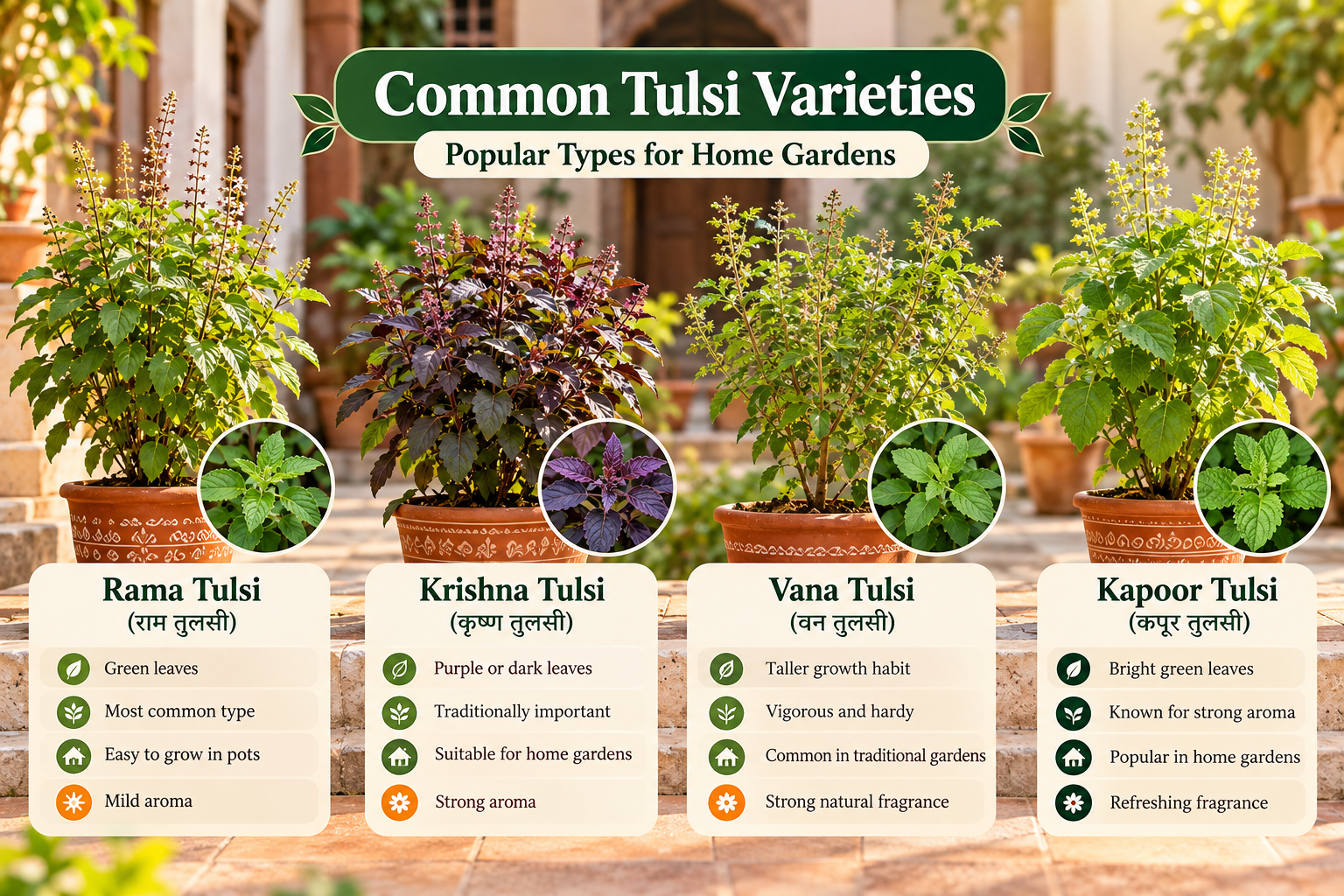
There is no single fixed number that covers every botanical species, cultivar and regional nursery type sold under the name “Tulsi.”
The commonly discussed household types include:
Rama Tulsi
Usually green-leaved and one of the most commonly grown household Tulsi types.
Krishna or Shyama Tulsi
Usually has darker purple or purplish foliage and stems.
Vana Tulsi
A taller, more vigorous type often associated with a stronger wild growth habit.
Kapoor Tulsi
Popular in home gardens for its strong aroma.
Which Tulsi Is Best for Home?
For a courtyard or balcony, Rama Tulsi and Krishna Tulsi are usually the easiest choices because they can remain productive in containers with regular pruning.
How to Grow Tulsi at Home
Sunlight: About 4–6 hours or more of good light
Soil: Loose, fertile and well-draining
Watering: Water when the upper soil begins drying
Container: Medium pot with drainage holes
Propagation: Seeds or cuttings
Common Problem
Tulsi often becomes weak when:
- overwatered
- grown in low light
- left in compact soil
- never pruned
Pinching the growing tips encourages bushier growth.
2. Bael / Bilva (बेल / बिल्व)

Botanical name: Aegle marmelos
Bael is one of the most important sacred trees of India, particularly in Shiva worship.
Government and forestry sources describe Bael as sacred in Hindu tradition, with its leaves traditionally offered to Shiva. Its trifoliate leaf is also given symbolic religious interpretations.
Which God Is Bael Associated With?
Bael is particularly associated with Lord Shiva.
Bael leaves are used in Shiva worship, including during Sawan and other religious observances.
Spiritual Meaning of Bael
According to tradition, the three leaflets of Bilva are symbolically linked in different interpretations with:
- Shiva's three eyes
- creation, preservation and destruction
- Brahma, Vishnu and Shiva
- the three gunas
Natural Benefits of Bael
Bael is also a useful fruit tree. It:
- tolerates hot and relatively dry conditions once established
- produces edible fruit
- can become a long-lived courtyard tree
- provides shade
- supports general garden biodiversity as a flowering and fruiting tree
How Many Bael Varieties Are There?
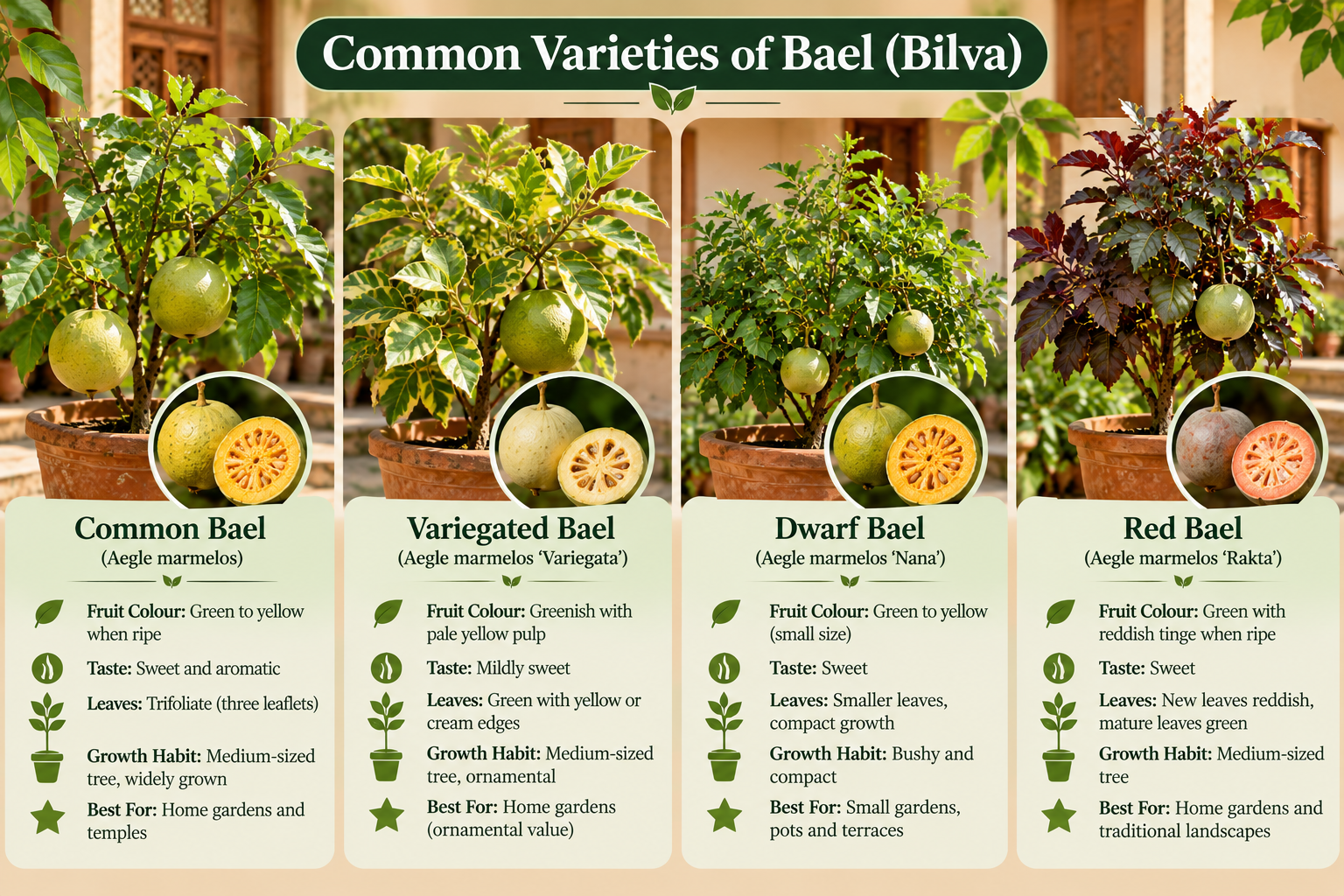
A precise total is difficult because India contains many local selections, germplasm lines and named cultivars.
ICAR reports that its research programme developed eight improved Bael varieties, and maintains hundreds of clonal and seedling accessions.
Examples of improved Bael cultivars include:
- Goma Yashi
- Thar Divya
- Thar Neelkanth
- Thar Srishti
- Thar Prakriti
ICAR identifies Thar Prakriti as one of its landmark Bael varieties.
Best Bael for a Home Courtyard
For fruit production, buying an improved grafted or budded nursery plant is usually more practical than planting an unknown seedling.
How to Grow Bael
Sunlight: Full sun
Soil: Well-draining soil
Watering: Moderate when young; avoid continuous waterlogging
Space: Medium to large courtyard
Propagation: Seed, budding or grafting
3. Peepal (पीपल)

Botanical name: Ficus religiosa
English name: Sacred Fig
Peepal is among the best-known holy trees in India.
Indian cultural sources describe Peepal as traditionally revered and sacred. A PIB source notes that Indian culture has historically revered trees such as Peepal and also refers to Krishna identifying himself with Ashwattha in the Bhagavad Gita.
Peepal is also deeply important in Buddhism because Gautama Buddha is traditionally believed to have attained enlightenment beneath a Ficus religiosa.
Spiritual Meaning of Peepal
Depending on tradition, Peepal may represent:
- continuity of life
- longevity
- enlightenment
- divinity
- spiritual reflection
Natural Benefits of Peepal
A mature Peepal tree can:
- provide extensive shade
- offer habitat for birds and insects
- produce figs eaten by wildlife
- become an important long-term landscape tree
How Many Peepal Varieties Are There?
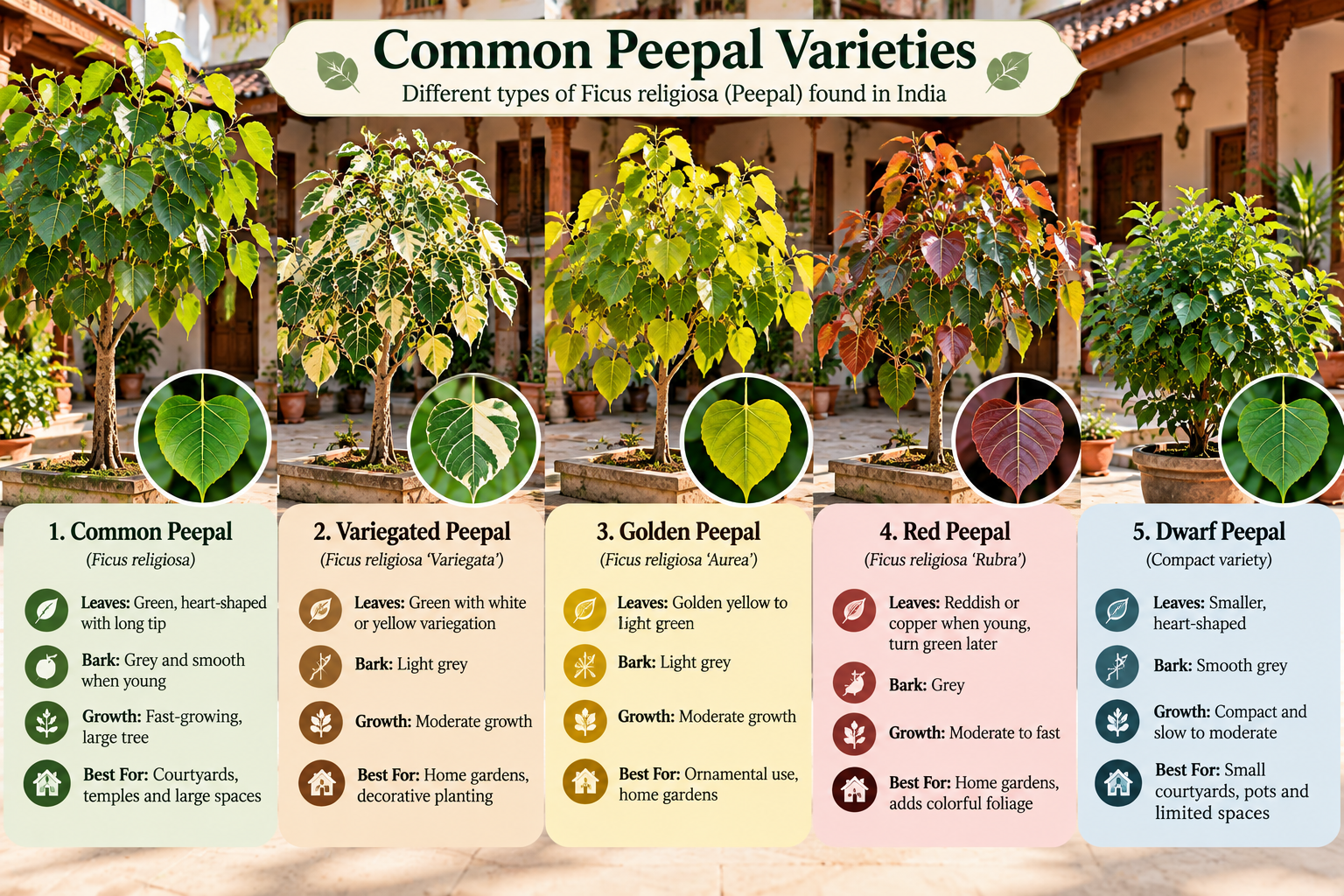
For home gardeners, the main point is that the sacred Peepal is the species Ficus religiosa.
Nurseries may sell ornamental selections or differently shaped plants, but these should not be confused with formally recognised fruit cultivars such as those found in mango or amla.
Can You Grow Peepal in a Home Courtyard?
Only if the courtyard is very large and the planting location is far from buildings.
Peepal can become a huge tree. A documented heritage Ficus religiosa in Tamil Nadu was about 21 metres tall.
Small Home Recommendation
Do not plant Peepal permanently in:
- tiny courtyards
- terrace pots
- spaces beside drainage pipes
- cracks near walls
- close to foundations
A small plant may survive temporarily in a pot, but it is not a true long-term container plant.
4. Banyan / Bargad / Vat Vriksha (बरगद / वट वृक्ष)

Botanical name: Ficus benghalensis
Banyan is one of the most iconic worship trees in India.
Former President A.P.J. Abdul Kalam described Banyan as holding a prominent position among the sacred trees of India and noted its significance across Hindu, Buddhist and Jain traditions.
IGNCA also identifies Nyagrodha, the Banyan, as one of five trees of special significance in Indian civilization.
Spiritual Meaning of Banyan
In different Indian traditions, Banyan can symbolize:
- longevity
- continuity
- shelter
- stability
- interconnected life
It is also connected with Vat Savitri traditions in Hindu practice.
Natural Benefits of Banyan
A mature Banyan can provide:
- enormous shade
- nesting and feeding areas for wildlife
- figs for birds and animals
- microhabitats among its aerial roots and branches
Banyan Varieties
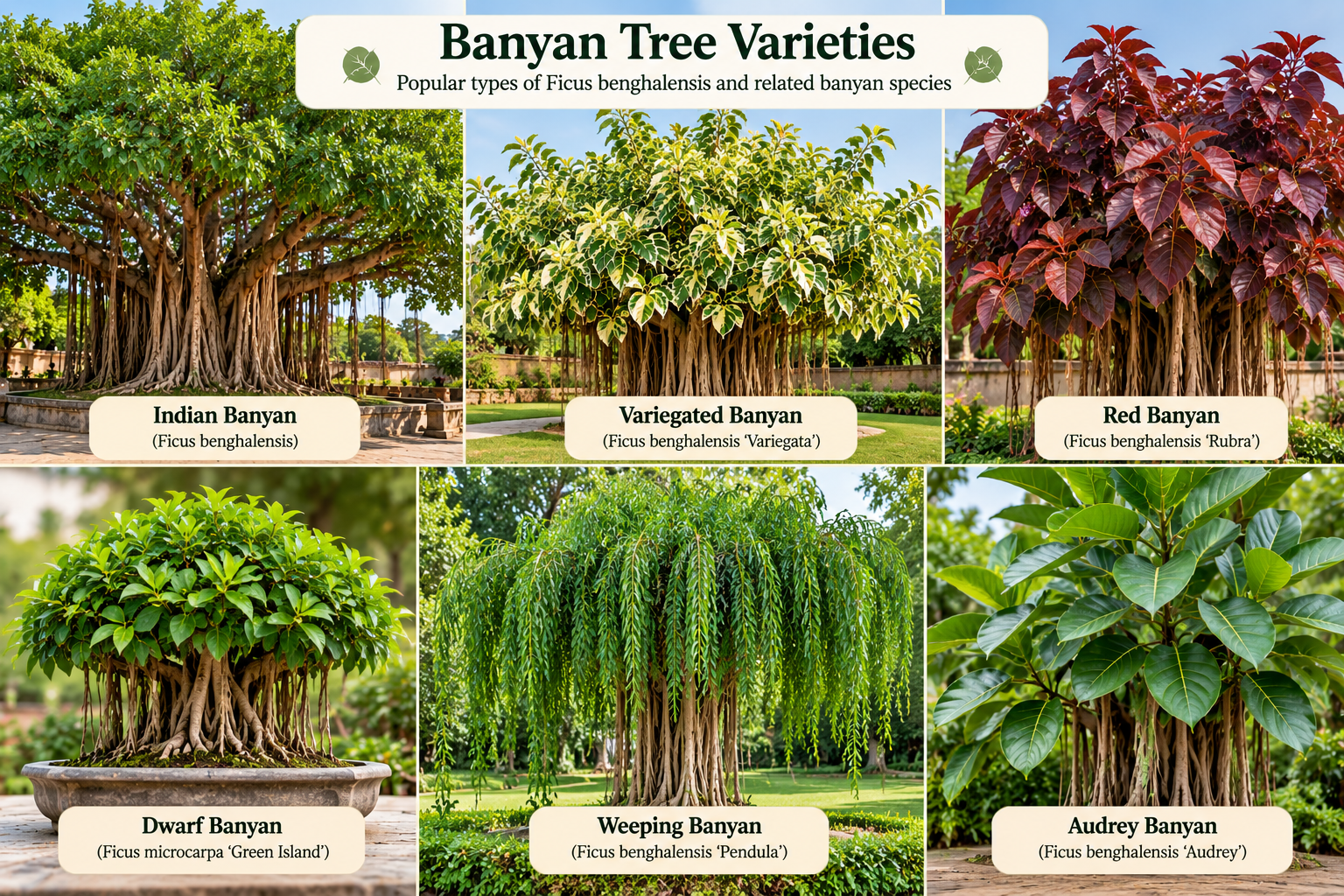
For this article, it is more accurate to talk about species and ornamental forms, not a fixed list of gardening varieties.
The sacred Indian Banyan is primarily Ficus benghalensis.
Can Banyan Grow in a Courtyard?
Only in very large properties.
It should not be recommended for ordinary small homes because:
- roots spread extensively
- aerial roots develop over time
- the canopy becomes enormous
- it needs open ground
For most homeowners, Banyan is better appreciated in parks, temples, village commons or large institutional grounds.
5. Banana (केला)

Botanical group: Musa spp.
Banana is both a fruit crop and an important ritual plant in many Indian traditions.
In some Hindu traditions, banana is associated with Vishnu and is used in auspicious ceremonies. Regional practices vary, so the exact religious interpretation can differ by community.
Spiritual Meaning of Banana
According to traditional usage, banana may represent:
- fertility
- abundance
- prosperity
- auspiciousness
Banana leaves and plants are also used decoratively in religious and wedding ceremonies in many parts of India.
Natural Benefits of Banana
Banana is useful for home gardens because:
- it grows quickly in warm weather
- it produces edible fruit
- its broad leaves add tropical shade and greenery
- leaves can contribute organic biomass after pruning
However, banana needs more water and nutrition than drought-tolerant sacred plants such as Bael.
How Many Banana Varieties Are There?
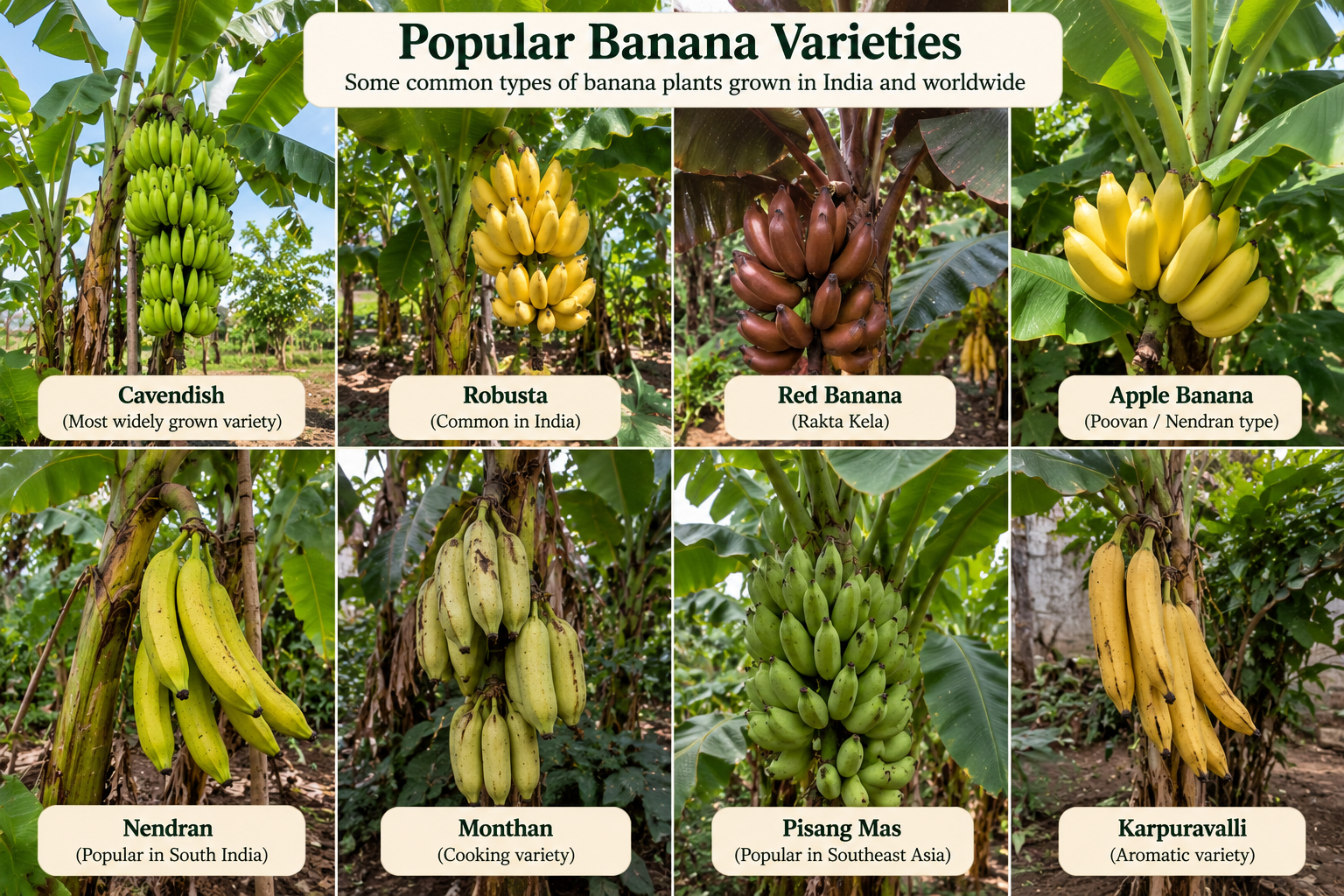
There are hundreds of banana cultivars and genetic accessions globally, and India grows many regional types.
Common Indian cultivars include:
- Grand Naine
- Robusta
- Nendran
- Poovan
- Rasthali
- Ney Poovan
ICAR also lists newer selections and varieties such as Kaveri Poovan and Kaveri Vaaman.
Which Banana Is Best for Home?
For limited space, shorter cultivars are easier to manage than very tall bananas.
Ask a local nursery for a dwarf or semi-dwarf variety suitable for your climate.
Growing Banana at Home
Sunlight: Full sun
Watering: Regular; do not allow prolonged drought
Soil: Fertile, moisture-retentive but well-draining
Space: Medium courtyard
Propagation: Suckers or tissue-culture plants
6. Lotus (कमल)
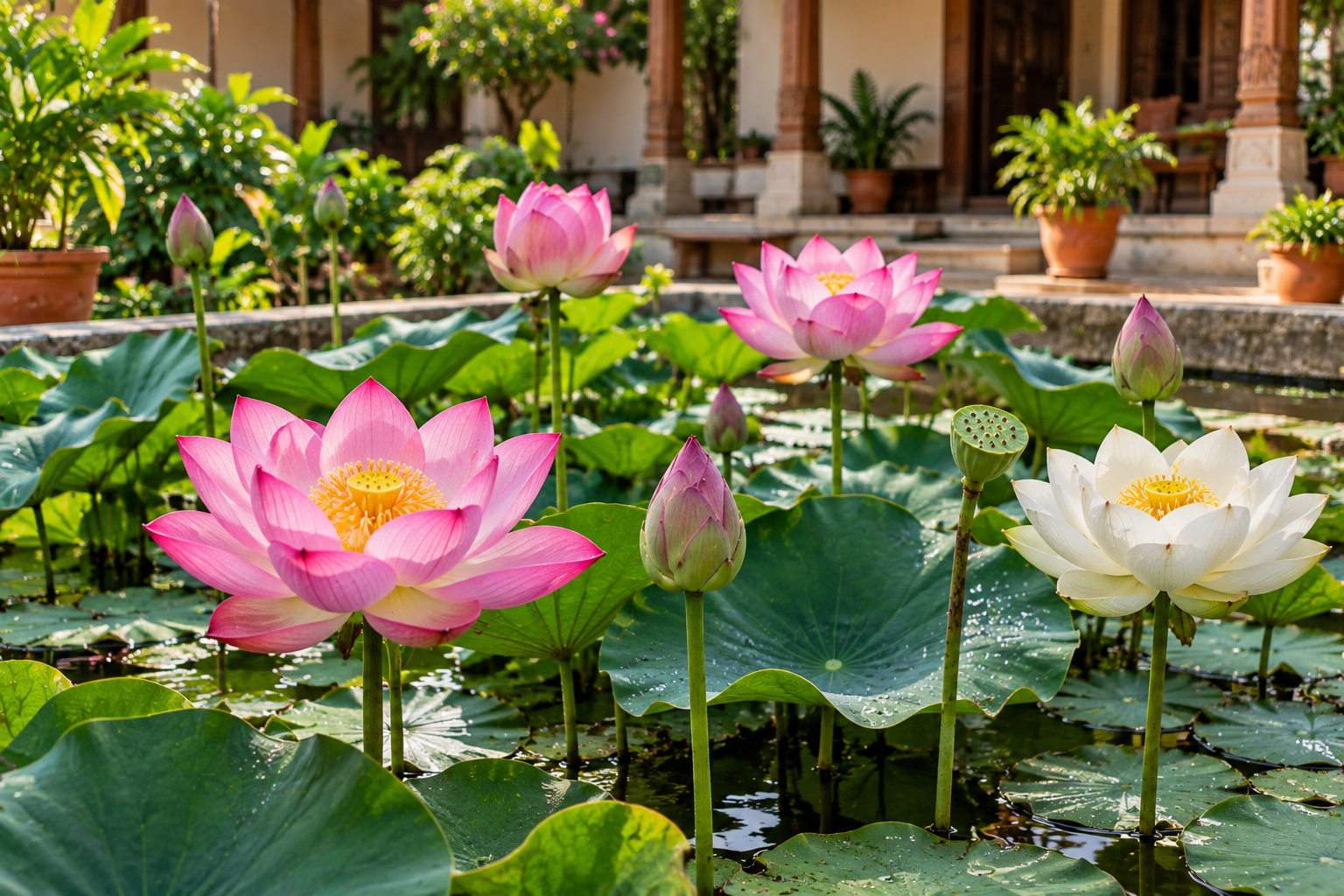
Botanical name: Nelumbo nucifera
Lotus is one of the most recognizable spiritual plants and sacred flowers in Indian culture.
Lotus imagery is strongly associated with Lakshmi, and traditional iconography often depicts her standing or sitting on a lotus and holding lotus flowers.
The lotus is also connected with Vishnu and Brahma in Hindu cosmological traditions.
Spiritual Meaning of Lotus
Traditionally, Lotus symbolizes:
- purity
- spiritual awakening
- prosperity
- divine beauty
- emergence from difficulty
Its symbolism is often explained through the flower rising cleanly above muddy water.
Natural Benefits of Lotus
In a garden, lotus:
- adds aquatic habitat
- provides shade over water
- produces large ornamental flowers
- can support insects visiting flowers
- works well in courtyard water features
Lotus Varieties
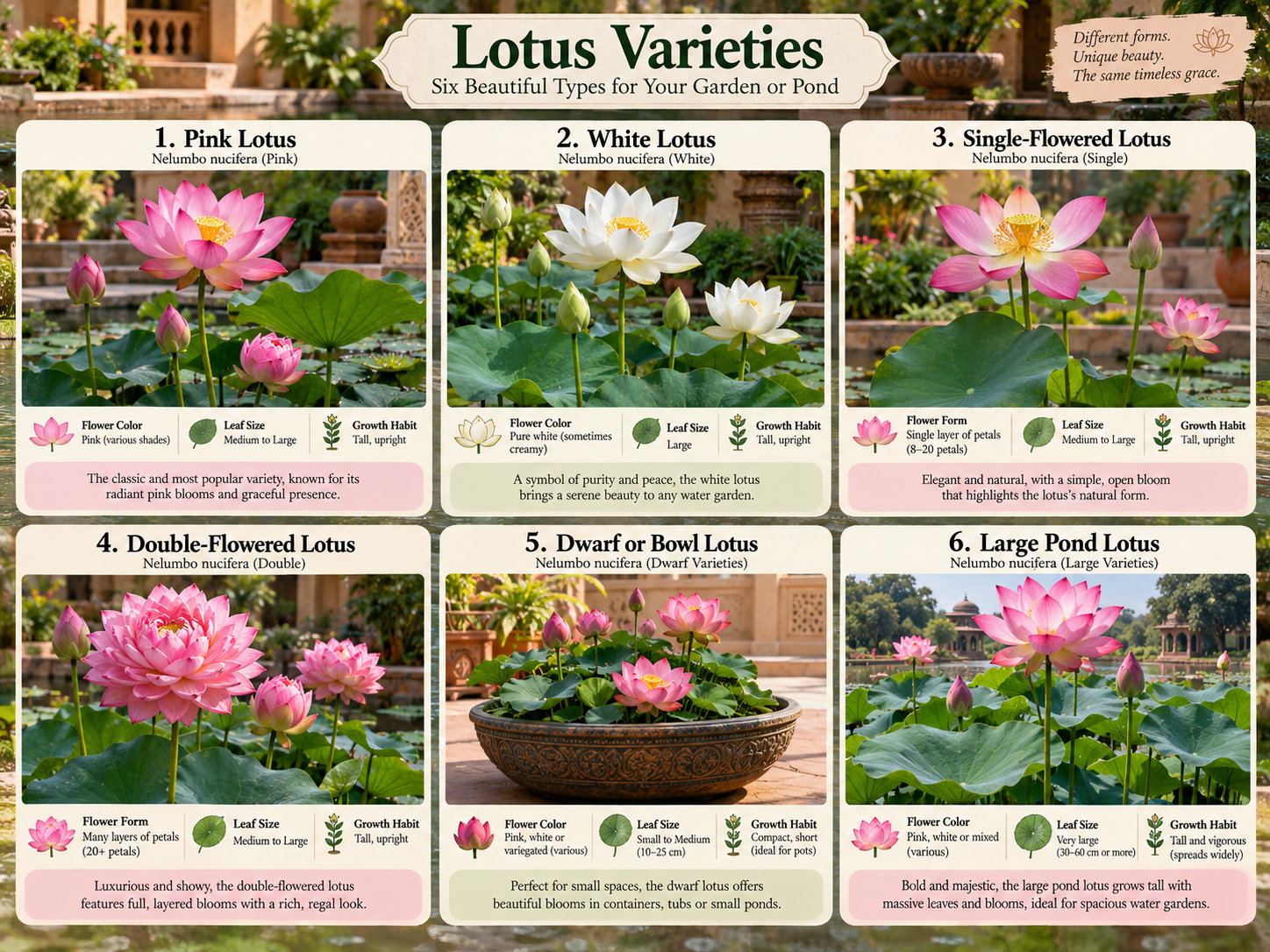
There are many cultivars of sacred lotus rather than one fixed number.
They can broadly be grouped into:
- pink lotus cultivars
- white lotus cultivars
- single-flowered forms
- double-flowered forms
- dwarf or bowl lotus types
- larger pond lotus cultivars
Best Lotus for a Courtyard
For a small home courtyard, choose a dwarf or bowl lotus cultivar rather than a vigorous large pond type.
How to Grow Lotus at Home
Container: Wide water tub without drainage holes
Sunlight: Strong direct sunlight
Medium: Heavy aquatic soil or suitable clay-based medium
Water: Permanent standing water
Propagation: Rhizomes are easier than seeds for beginners
7. Parijat / Harsingar (पारिजात / हरसिंगार)
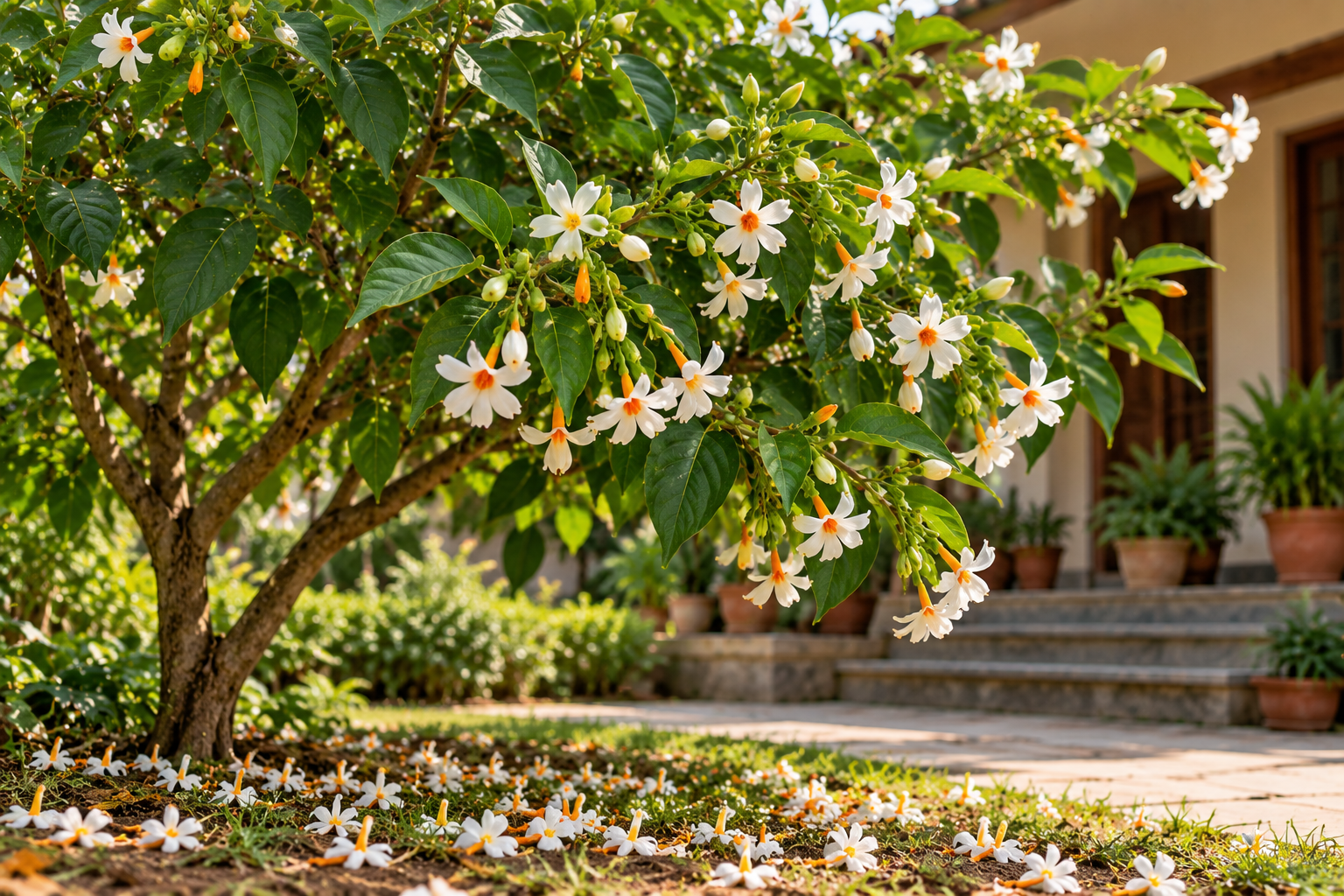
Botanical name: Nyctanthes arbor-tristis
Parijat is a beautiful courtyard tree known for fragrant white flowers with orange centres.
Harsingar, also known as Parijat or Night-flowering Jasmine, is a small deciduous tree used for religious offerings and traditional purposes.
Parijat also has a famous cultural connection with Krishna through the Parijata story.
Spiritual Meaning of Parijat
According to Hindu tradition and mythology, Parijat is associated with:
- Krishna
- celestial beauty
- devotion
- sacred offerings
Natural Benefits of Parijat
It is one of the more practical holy plants for a home courtyard because:
- it remains smaller than Peepal or Banyan
- flowers are strongly fragrant
- flowers open at night
- fallen flowers can be collected in the morning
- flowers attract nocturnal pollinating insects such as moths
Its blooming period is generally around August to December, and the flowers open at night and fall in the morning.
Parijat Varieties
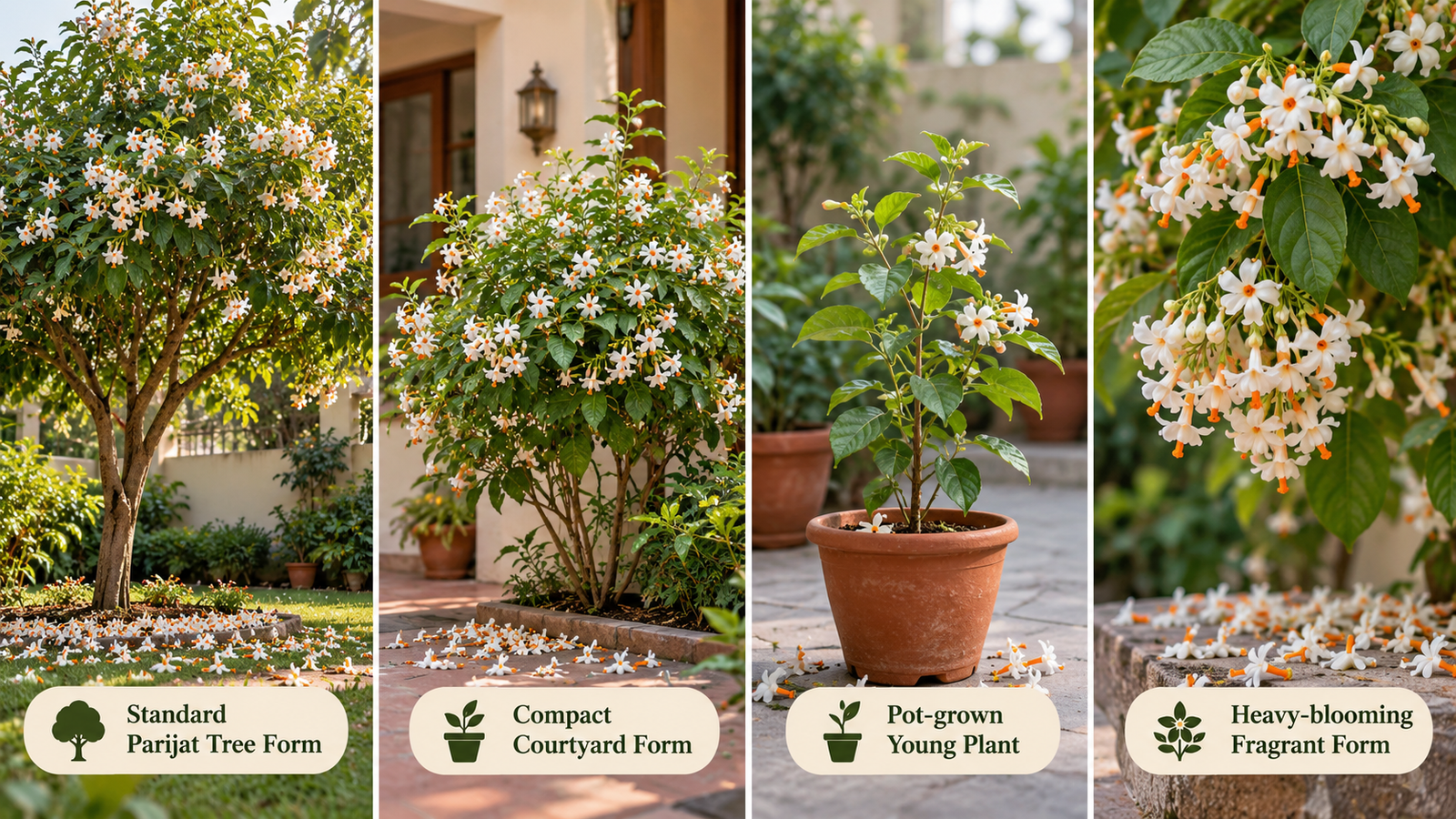
Parijat does not have the huge mainstream cultivar list found in mango or banana.
Most nurseries sell the species Nyctanthes arbor-tristis.
There may be local forms differing in:
- flower size
- growth habit
- flowering intensity
- plant vigour
Avoid nursery listings that claim dozens of scientifically recognised Parijat varieties without proper identification.
Growing Parijat
Sunlight: Full sun to bright partial sun
Watering: Moderate
Soil: Well-draining garden soil enriched with compost
Space: Medium courtyard
Propagation: Seed or cuttings
8. Amla (आंवला)
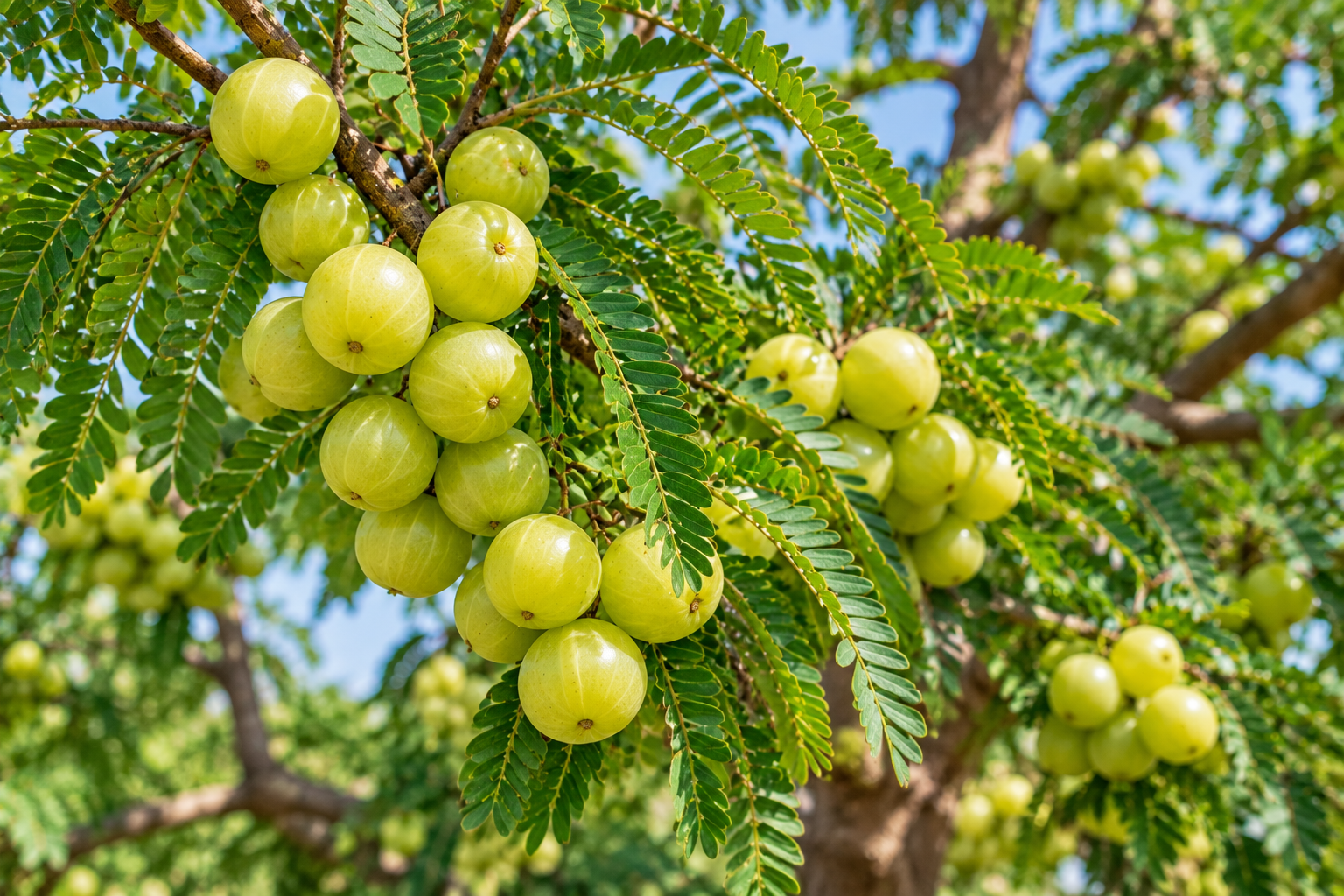
Botanical name: Phyllanthus emblica
Also known as Indian gooseberry.
Amla is both a culturally important tree and a widely grown fruit plant.
Traditional sources describe Amla as worshipped in religious observances, particularly in Kartik-related traditions.
Spiritual Meaning of Amla
Depending on regional tradition, Amla may be associated with:
- sacred household observance
- purity
- longevity
- Vishnu-related worship traditions
Natural Benefits of Amla
Amla:
- produces edible fruit
- can tolerate Indian climatic conditions well
- develops into a useful long-term fruit tree
- provides shade and habitat value as it matures
Common Amla Varieties in India
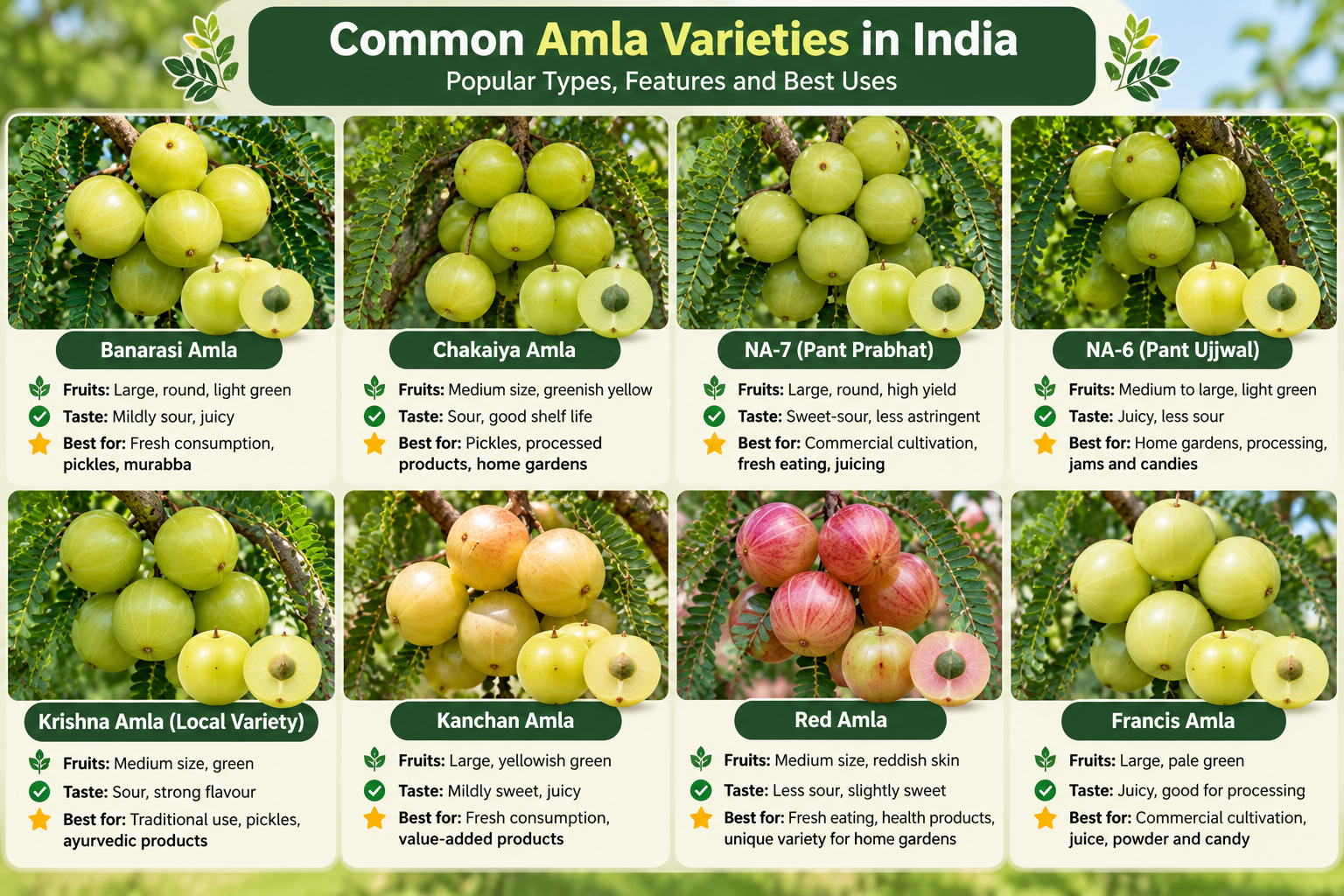
Frequently grown cultivars include:
- NA-7
- Krishna
- Kanchan
- Chakaiya
- Banarasi
There are additional regional and improved cultivars, so this is not a complete count.
Which Amla Is Best for Home?
For fruit quality and earlier bearing, buy a grafted or budded named variety from a reliable nursery.
Growing Amla at Home
Sunlight: Full sun
Watering: Regular while young; moderate after establishment
Soil: Well-draining garden soil
Space: Medium to large courtyard
Propagation: Grafted or budded plants preferred for fruit production
9. Mango (आम)
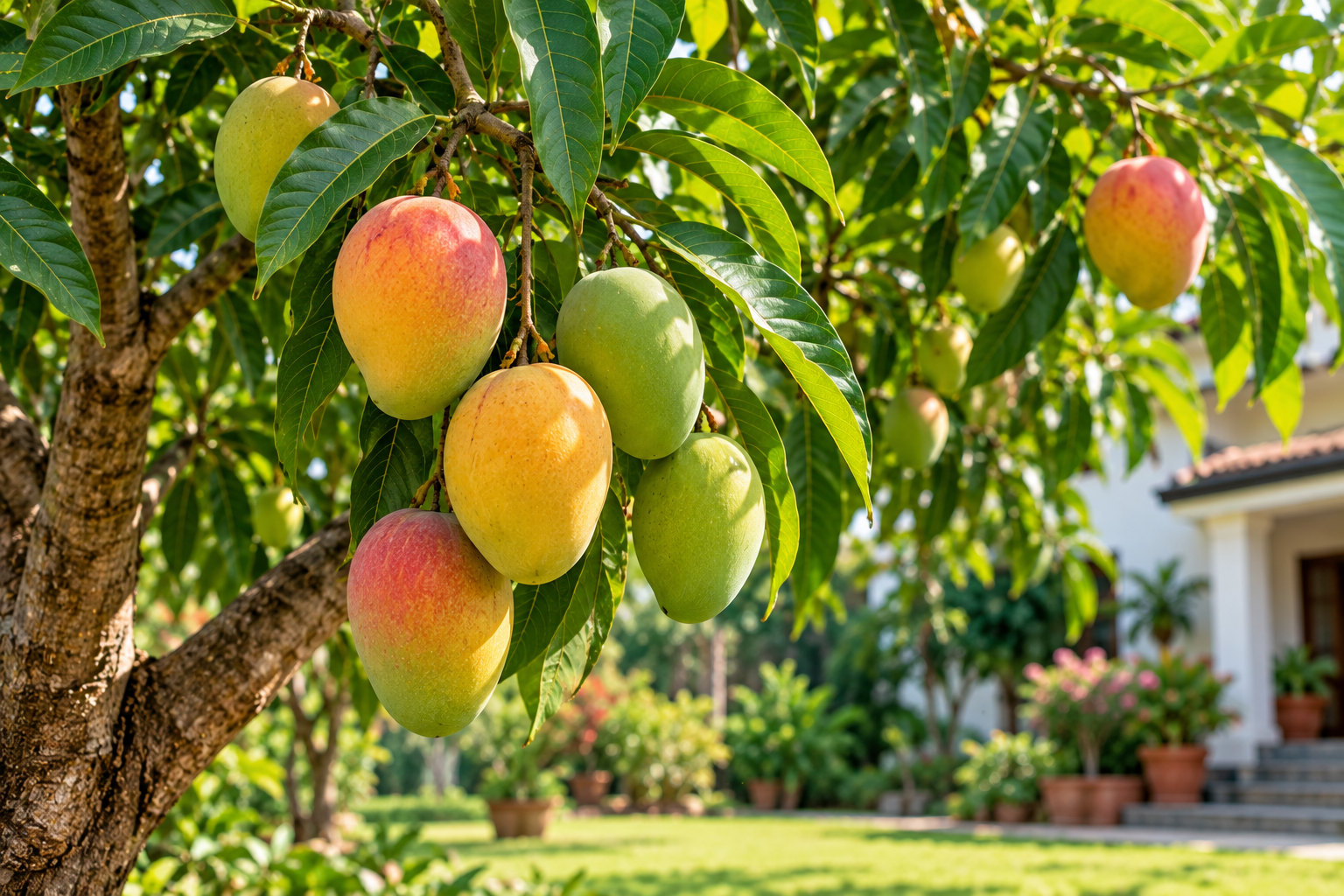
Botanical name: Mangifera indica
Mango is one of India's most culturally important fruit trees.
Traditional sources describe mango leaves and flowers as part of auspicious and ritual practices. Mango-leaf festoons have historically been used during marriages and other ceremonies.
Spiritual Meaning of Mango
In Indian cultural traditions, mango is commonly associated with:
- auspicious beginnings
- fertility
- abundance
- celebration
- ceremonial decoration
Natural Benefits of Mango
A mature mango tree:
- provides large amounts of shade
- produces edible fruit
- provides habitat and food resources for wildlife
- can become a long-lived landscape tree
How Many Mango Varieties Are There?
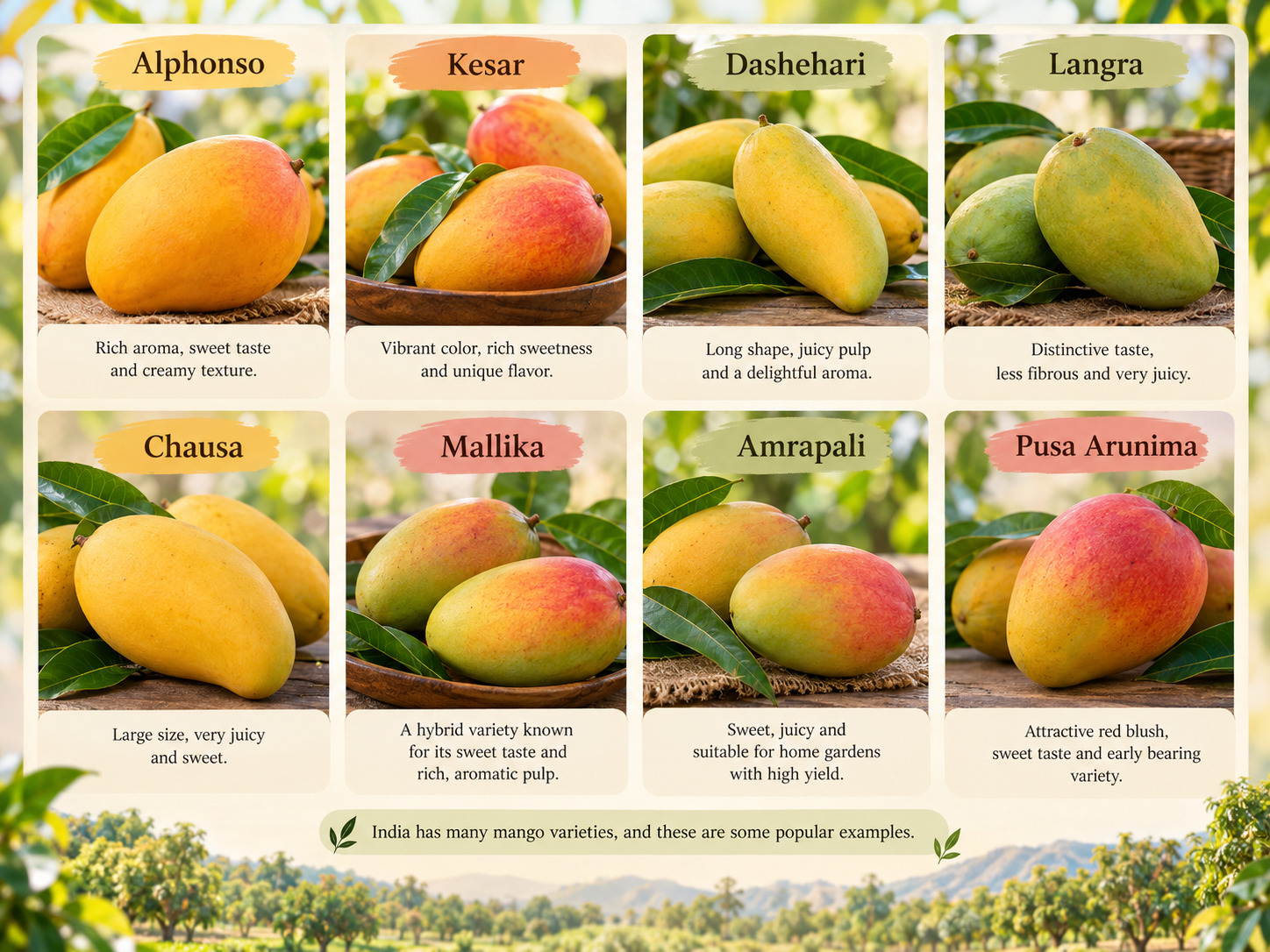
India has a very large number of mango cultivars, including many regional and improved varieties.
Well-known examples include:
- Dashehari
- Langra
- Alphonso
- Kesar
- Chausa
- Mallika
- Amrapali
- Pusa Arunima
For a courtyard, vigour matters more than popularity.
ICAR describes Amrapali as a dwarf, regular-bearing hybrid suitable for high-density planting.
Best Mango for a Home Courtyard
If space is limited, consider:
- Amrapali
- other semi-dwarf or compact grafted cultivars recommended locally
Do not grow a random seedling mango in a small courtyard if you expect to control its final size easily.
Growing Mango
Sunlight: Full sun
Watering: Regular while establishing; avoid constant waterlogging
Soil: Deep, well-draining soil
Space: Medium-large to very large
Propagation: Grafted plant preferred
10. Ashoka / Sita Ashoka (अशोक / सीता अशोक)
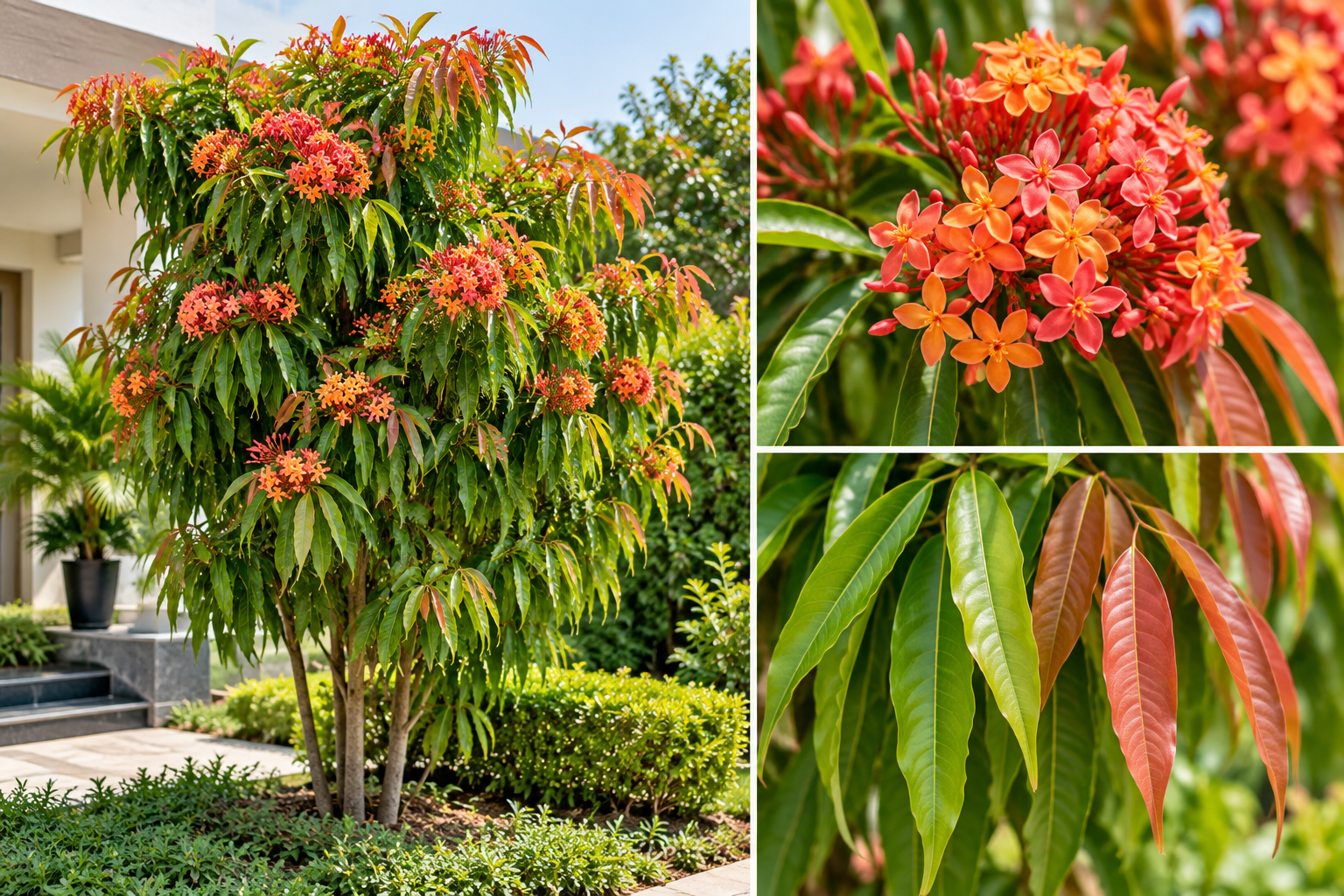
Botanical name: Saraca asoca
Ashoka is an important sacred and cultural tree in India.
It is also important not to confuse true Ashoka with the commonly planted tall narrow avenue tree known as False Ashoka.
True Ashoka vs False Ashoka
True Ashoka
Botanical name: Saraca asoca
It has:
- broader foliage
- clusters of orange to reddish flowers
- traditional sacred and medicinal importance
False Ashoka / Mast Tree
Current/common botanical reference: Monoon longifolium, historically Polyalthia longifolia.
It is:
- tall and narrow
- commonly used as an ornamental screening tree
- frequently sold under the name “Ashoka”
Spiritual Meaning of Ashoka
Traditionally, Ashoka is associated with:
- freedom from sorrow
- feminine symbolism
- fertility
- sacred groves and religious landscapes
The name itself is commonly interpreted through the Sanskrit idea of “without sorrow.”
Natural Benefits
True Ashoka is useful as:
- an ornamental flowering tree
- a shade plant
- a biodiversity-supporting garden tree
- a culturally significant native landscape plant
Ashoka Varieties

For a home gardener, the most important distinction is not between dozens of cultivars, but between:
- True Ashoka – Saraca asoca
- False Ashoka – Polyalthia/Monoon longifolium
If your aim is to grow the traditionally sacred Ashoka, confirm the botanical name Saraca asoca at the nursery.
Growing Ashoka
Sunlight: Sun to partial sun depending on climate
Watering: Regular when young
Soil: Fertile and well-draining
Space: Medium-large courtyard
Propagation: Seeds or nursery saplings
Which Sacred Plants Are Best for a Small Home Courtyard?
Not all sacred plants of India are suitable for limited space.
Best for Small Courtyards or Pots
- Tulsi
- dwarf Lotus in a water container
- young Parijat in a controlled space
- compact Banana variety
- selected container-friendly sacred flowering plants
Better for Medium Courtyards
- Parijat
- Bael with pruning
- dwarf or compact Mango variety
- Banana
- selected Amla plant
Better for Large Gardens Only
- Peepal
- Banyan
- full-size Mango
- large Amla
- large Bael
Sacred Trees of India: Which Ones Should Not Be Planted Near a House?
This is an important practical question often missing from articles about holy trees in India.
Peepal and Banyan may be culturally important, but both can become enormous trees.
Avoid planting them directly beside:
- house foundations
- underground pipes
- drains
- boundary walls
- paved courtyards
- terrace structures
Respect for a sacred tree should also include planting it where it has enough room to mature properly.
Religious Benefit vs Natural Benefit: What Is the Difference?
When discussing spiritual plants, two different kinds of benefits should be kept separate.
Benefits According to Faith
These may include beliefs associated with:
- prosperity
- purity
- protection
- blessings
- devotion
- spiritual well-being
Natural or Gardening Benefits
These can include:
- fruit production
- shade
- flowers
- fragrance
- pollinator support
- wildlife habitat
- home greenery
- soil cover
- food production
Keeping these categories separate makes the guide more useful and accurate.
Which Sacred Plant Variety Is Best for Home Gardening?
If you want the most practical choices rather than only the most famous sacred trees of India, consider:
| Plant | Recommended Home Type | Why |
|---|---|---|
| Tulsi | Rama or Krishna Tulsi | Easy in pots |
| Bael | Improved grafted cultivar | Better fruit quality |
| Banana | Dwarf / semi-dwarf cultivar | Easier to manage |
| Lotus | Dwarf bowl lotus | Good for small water containers |
| Parijat | Standard nursery plant | Courtyard-friendly size |
| Amla | Grafted named cultivar | More predictable fruiting |
| Mango | Amrapali or compact grafted cultivar | Easier size control |
| Ashoka | True Saraca asoca | Correct sacred species |
Common Mistakes When Growing Sacred Plants at Home
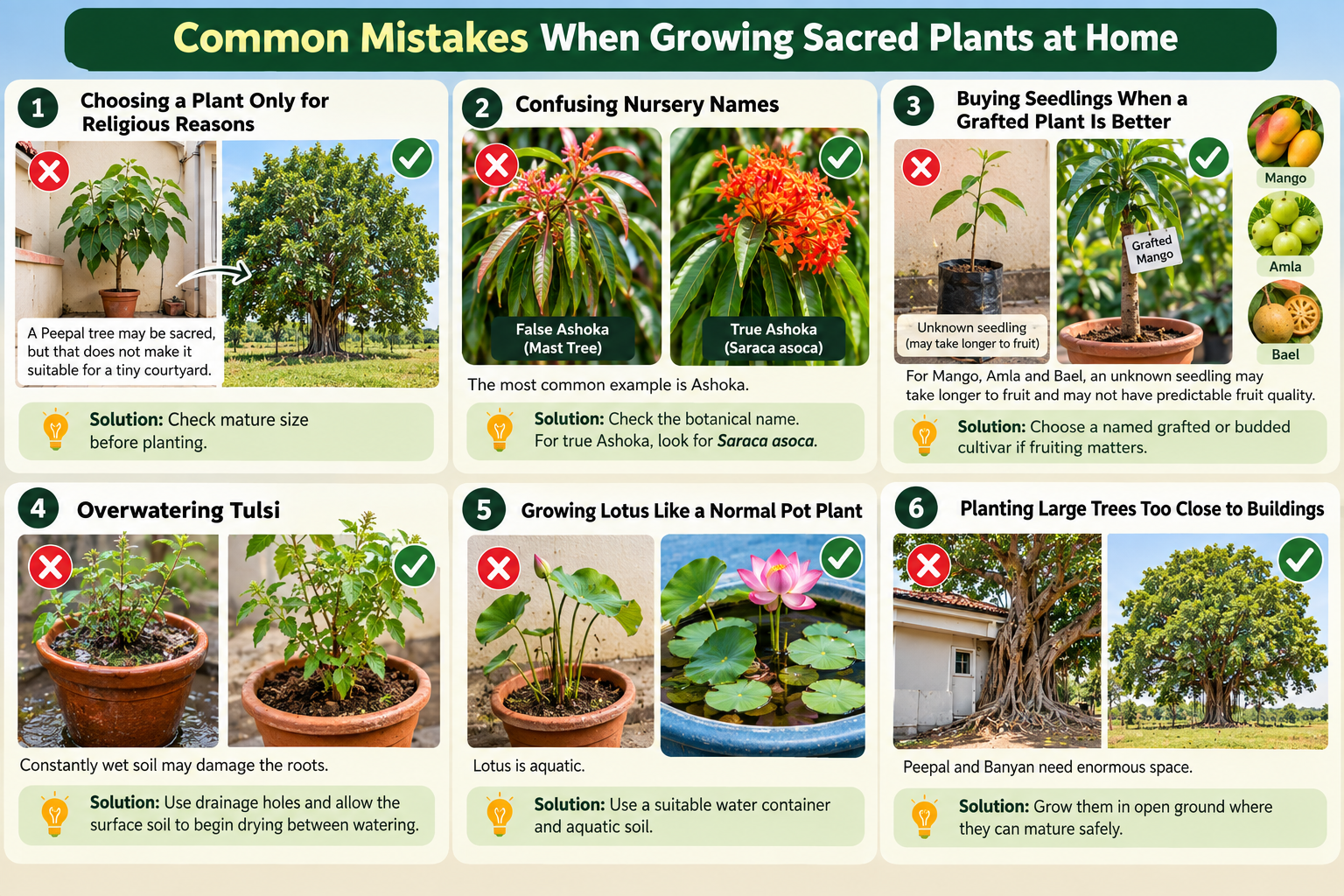
1. Choosing a Plant Only for Religious Reasons
A Peepal tree may be sacred, but that does not make it suitable for a tiny courtyard.
2. Confusing Nursery Names
The most common example is Ashoka.
3. Buying Seedlings When a Grafted Plant Is Better
For Mango, Amla and Bael, an unknown seedling may take longer to fruit and may not have predictable fruit quality.
4. Overwatering Tulsi
Constantly wet soil may damage the roots.
5. Growing Lotus Like a Normal Pot Plant
Lotus is aquatic.
6. Planting Large Trees Too Close to Buildings
Peepal and Banyan need enormous space.
Holy Plants, Sacred Trees and Tree Worship in India
The tradition of tree worship in India is closely connected with the idea that trees can represent continuity, shelter, fertility, divine presence or protection.
Peepal, Banyan and Bael are among the best-known worship trees in India, while Tulsi is particularly associated with household worship.
Indian government and cultural sources have repeatedly documented the religious and social importance of trees such as Peepal, Banyan and Bael.
For gardeners today, this tradition can also encourage something practical: planting species thoughtfully and giving long-lived trees enough space to survive for generations.
What Are the “5 Sacred Plants in Vedas”?
The search phrase “5 sacred plants in Vedas” is common online, but it should be used carefully.
There is not one simple universal modern list that can automatically be labelled “the five sacred Vedic plants” without specifying the particular text, tradition or later interpretation.
Some plants do have documented early textual associations. For example, an ICFRE publication notes Bael's mention in the Yajurveda and its long religious history.
So rather than presenting an unsupported fixed list, it is more accurate to say that different Vedic, Puranic and later traditions give sacred significance to different plants and trees.
This distinction is important because many popular modern lists mix:
- Vedic references
- Puranic traditions
- local customs
- later temple practices
Sacred Flower Plants You Can Also Grow at Home
If you do not have enough space for large sacred trees, a sacred flower or flowering pooja plant can be a practical alternative.
Depending on local tradition, home gardeners may also grow:
- Jasmine
- Marigold
- Hibiscus
- Aparajita
- Champa
- Lotus
- Parijat
These plants are easier to manage in courtyards and pots than Peepal or Banyan.
Sacred Plant Growing Checklist
Before bringing a sacred plant home, check:
- What is its correct botanical name?
- What is its Hindi name?
- Is it a tree, shrub, herb or aquatic plant?
- How tall will it become?
- Can it remain in a pot long-term?
- Does it need full sun?
- How much water does it need?
- Will its roots eventually need open ground?
- Is there a dwarf or compact variety?
- Is a grafted plant better than a seedling?
- Is the religious association regional or widespread?
- Are the claimed benefits based on faith, traditional use or horticulture?
Final Thoughts
India's relationship with plants goes far beyond gardening. Many sacred plants, holy plants and sacred trees of India have been part of household rituals, temple traditions, mythology and community life for centuries.
Tulsi can fit into almost any sunny courtyard. Bael has a strong connection with Shiva worship. Peepal and Banyan are among India's most culturally important trees, but their mature size makes them unsuitable for most small homes. Lotus brings sacred symbolism into a courtyard water garden, while Parijat combines religious use with fragrant flowers and a manageable growth habit.
The best choice is therefore not simply the plant considered most sacred.
Choose a plant that fits your:
- faith or cultural tradition
- climate
- courtyard size
- sunlight
- available soil
- long-term maintenance capacity
That way, the plant can be respected not only symbolically but also by giving it the conditions it needs to thrive.
Frequently Asked Questions
Sacred plants are plants or trees given religious, spiritual or ritual importance within a culture or faith tradition.
Common examples include Tulsi, Bael, Peepal, Banyan, Lotus, Parijat, Amla, Mango and Ashoka.
Tulsi, Parijat and dwarf Lotus are among the easier options for smaller courtyards. Banana can also work where the climate and space are suitable.
Bael or Bilva is particularly associated with Shiva worship, and its leaves are traditionally offered to Shiva.
Tulsi has a particularly strong association with Vishnu traditions, including Tulsi Vivah.
The Lotus is strongly associated with Lakshmi in Hindu iconography and religious symbolism.
Peepal or Ashwattha has a documented association with Krishna in the Bhagavad Gita tradition. Parijat is also connected with Krishna through a well-known mythological tradition.
A young Peepal may survive temporarily in a pot, but it is a very large tree and is not suitable as a permanent small-container plant.
Only if the courtyard or property is very large. Banyan develops a huge canopy and extensive root system.
Yes. Rama Tulsi is generally green-leaved, while Krishna or Shyama Tulsi usually has darker purple or purplish foliage.
There are numerous local types and germplasm lines. ICAR reports that one of its research programmes developed eight improved Bael varieties, including Goma Yashi and several Thar selections.
Amrapali is a useful option because it is described as a dwarf and regular-bearing mango hybrid.
No. True Ashoka is Saraca asoca. The commonly planted narrow ornamental tree historically called Polyalthia longifolia is known as False Ashoka.
Tulsi, Parijat and dwarf Lotus are among the most manageable. A compact Banana or carefully chosen grafted fruit tree may also work if enough space and sunlight are available.
अगर जगह कम है, तो तुलसी सबसे आसान विकल्पों में से एक है। मध्यम आकार के आंगन के लिए पारिजात, केला या छोटा ग्राफ्टेड बेल का पौधा भी अच्छा विकल्प हो सकता है।
हाँ, छोटे या युवा बेल के पौधे को बड़े गमले में कुछ समय तक उगाया जा सकता है, लेकिन लंबे समय के लिए इसे खुली जमीन और पर्याप्त जगह की जरूरत होती है।
पीपल एक बहुत बड़ा पेड़ बन सकता है। इसलिए इसे घर की नींव, दीवारों, पाइप या ड्रेनेज के पास लगाने से बचना बेहतर है।
बरगद और पीपल दोनों Ficus समूह के पेड़ हैं, लेकिन बरगद में बड़ी शाखाएं और हवाई जड़ें विकसित होती हैं, जबकि पीपल की पत्तियां दिल के आकार की और लंबी नोक वाली होती हैं।
सच्चा अशोक Saraca asoca है। इसकी पत्तियां चौड़ी होती हैं और इसमें नारंगी से लाल रंग के फूलों के गुच्छे आते हैं। लंबा और बहुत पतला सजावटी पेड़ अक्सर False Ashoka होता है।
तुलसी, बेल, पारिजात, कमल, केला, चमेली, गुड़हल और अपराजिता जैसे पौधे अलग-अलग धार्मिक परंपराओं में पूजा या धार्मिक उपयोग से जुड़े हैं।
तुलसी, पारिजात, बौना कमल और कुछ छोटे आकार के धार्मिक फूल वाले पौधे कम जगह के लिए बेहतर विकल्प हैं।
नहीं। कमल एक जलीय पौधा है और इसे पानी वाले चौड़े कंटेनर या छोटे तालाब में उगाना चाहिए।
Tulsi sabse easy options me se ek hai. Isko medium pot, achhi sunlight aur proper drainage ke saath easily grow kiya ja sakta hai.
Young Parijat ko large pot me grow kiya ja sakta hai, lekin long-term healthy growth ke liye bigger container ya ground planting better hoti hai.
Nahi. Young Peepal temporary pot me reh sakta hai, lekin mature Peepal ek bahut bada tree banta hai aur permanent small-pot plant nahi hai.
Plant ka botanical name, variety, age, grafted ya seed-grown status, mature size aur sunlight requirement poochna useful hota hai.
Rama Tulsi aur Krishna Tulsi dono popular household options hain. Dono pots me easily manage ki ja sakti hain.
Agar predictable fruit quality aur earlier bearing chahiye, to grafted ya budded named variety lena generally better hota hai.
Home gardening ke liye grafted mango plant zyada practical hota hai because seed-grown plant ko fruit dene me kaafi time lag sakta hai aur fruit parent jaisa ho ye guaranteed nahi hota.
Haan, Tulsi, dwarf Lotus, small Parijat aur kuch sacred flowering plants balcony me grow kiye ja sakte hain, bas sunlight aur space suitable hona chahiye.
True Ashoka ka botanical name Saraca asoca hai. False Ashoka ko historically Polyalthia longifolia kaha gaya hai aur iska shape tall aur narrow hota hai.
Religion ke basis par soil alag nahi hoti. Plant ki species ke according soil choose karni chahiye—jaise Tulsi ko well-draining soil aur Lotus ko aquatic setup chahiye.